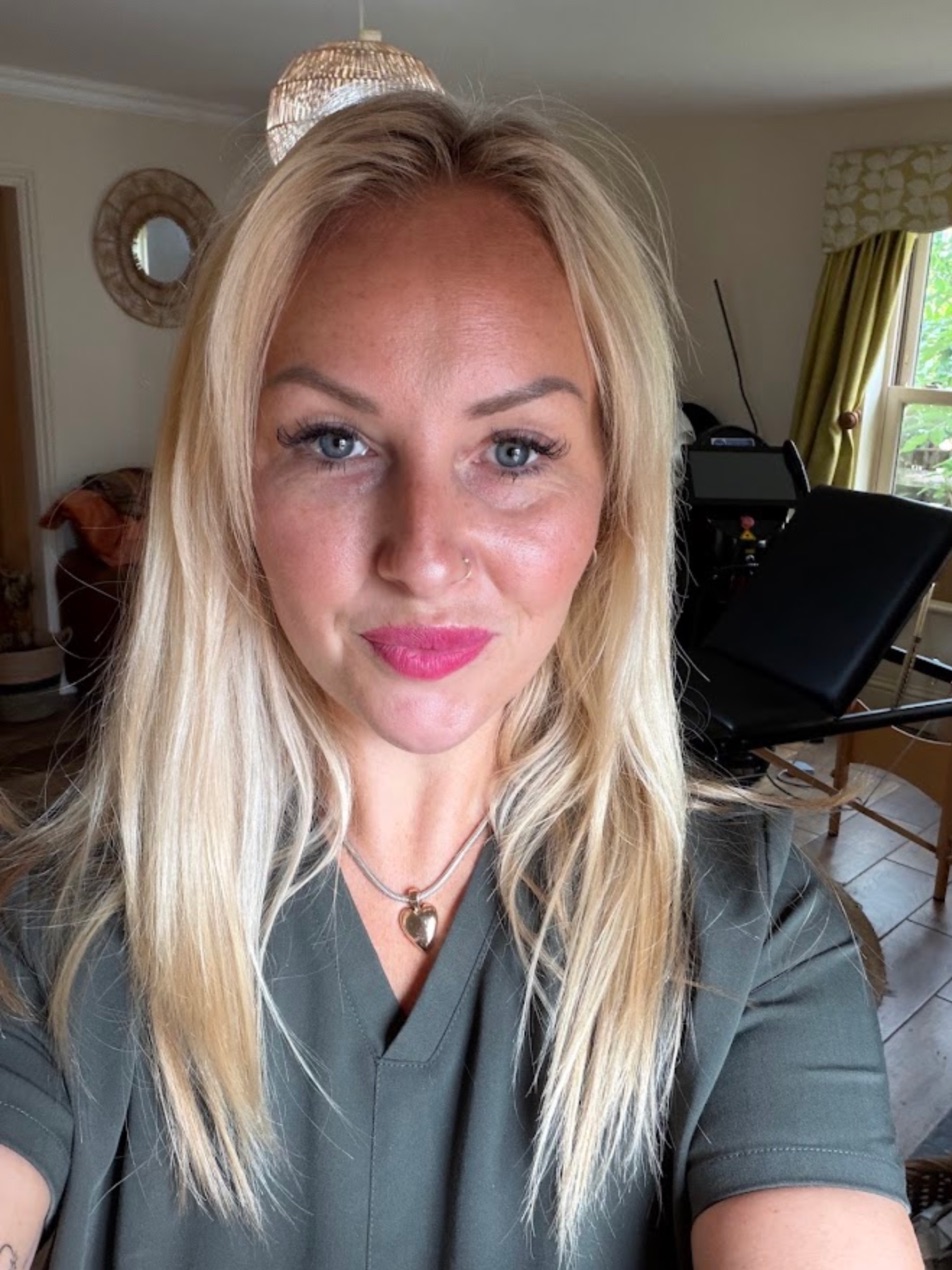
Alicia Marsland
Registered nurse · leads the clinic
- Registered nurse on the Nursing and Midwifery Council register
- Seventeen years in clinical practice
- Trained in all the clinic's laser treatments, including tattoo removal
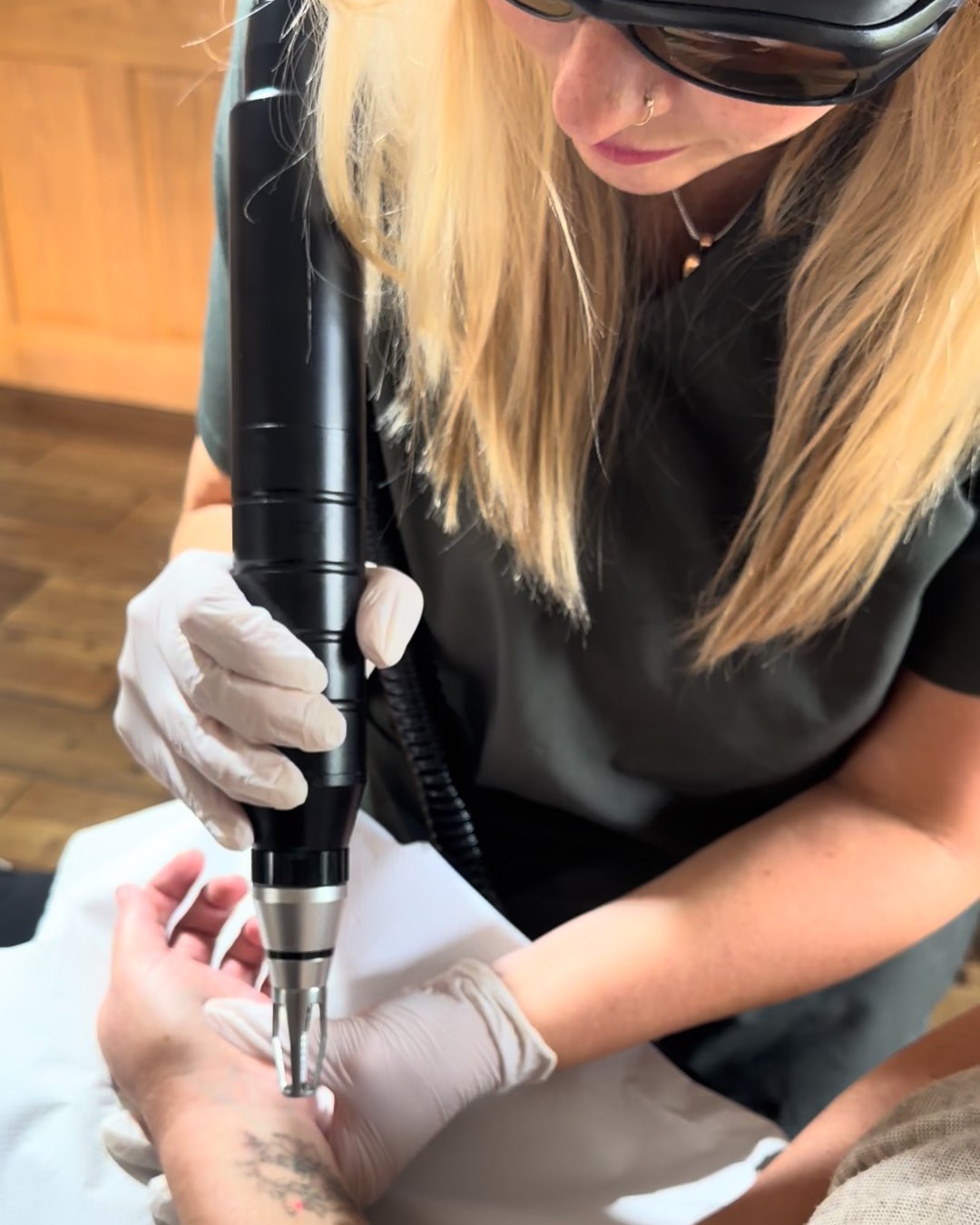
Laser breaks tattoo ink into fragments your body clears over the following weeks, so removal takes a course of sessions, six to eight weeks apart. Some tattoos clear completely; others fade a long way rather than clearing. It depends on your tattoo, and we'll be straight with you about yours. Lightening one for a cover-up takes fewer sessions.
£45a session, fromPriced by size and confirmed at your patch test.
The numbers, up front
Results
Each session breaks up more ink, and your body clears it in the weeks between. That's why sessions are six to eight weeks apart, and why it can't be rushed. Tap through the stages.
Before. Dense, dark ink. Your patch test comes first, at least 24 hours before the first session, to see how your skin and the ink respond.
Early sessions. After the first sessions, six to eight weeks apart, the ink starts to lighten and break up as your body clears it.
Mid-course. Black and dark blue usually keep clearing. Green, light blue, yellow, white and pastel shades may barely change, and red varies.
Removed. Where the ink responds well, a course can clear it completely, as drawn here. Other tattoos fade a long way instead, sometimes leaving a faint shadow or outline. It depends on your tattoo, and we'll tell you what to expect at your free patch test.
Diagram, not a client result. Some tattoos clear completely; others fade a long way. It depends on the tattoo.
Photos of our own clients' tattoos go here as their courses finish: same light, unretouched, shared with written permission, and captioned with the ink colours, the number of sessions and the time since the last one.
Estimate yours
For each row, see which column your tattoo fits. Mostly 'fewer': likely fewer sessions than usual. A mix: about typical. Mostly 'more': likely more. The same things decide whether it's likely to clear completely. It can't give you a number, and neither can a photo.
| Usually fewer sessions | Usually more sessions | |
|---|---|---|
| Your skin tone | Lighter skin | Darker skin, which is treated at gentler settings to protect it |
| Where it is | Head, neck, chest or back | Lower arms, hands, lower legs or feet, where circulation is weaker |
| The colours | Black or dark blue only | Several colours. Green and light blue are stubborn, yellow, white and pastels may barely respond, and red varies |
| How much ink | Fine lines, a simple design, or homemade ink | Dense shading, solid fill or detailed professional work |
| Scarring | Smooth, flat skin | Ink in scarred or raised skin |
| Layering | A single tattoo | A tattoo that already covers an older one |
| Its age | Many years old | Recent |
Based on the six factors in the Kirby-Desai scale, published in 2009 to estimate a course of laser tattoo removal, plus the tattoo's age. A guide, not a prediction: people clear ink at different rates. We'll give you a range at your patch test.
Who it's for
Often among the quickest to remove. Older ink has had years to break down, and homemade ink usually sits shallower and thinner in the skin.
You usually don't need it fully removed. Three to five sessions is often enough to lighten old work for your artist to design over. Ask them first, and bring us their view.
A design or a placement that no longer feels like you. We'll talk through whether it's likely to clear completely, or fade a long way, before you commit to anything.
We'll look at it and be straight about the odds. Red varies. Green and light blue are stubborn. Yellow, white and pastel shades often barely respond.
Some medicines, including certain antibiotics and acne treatments, make skin more sensitive to light. Tell us everything you take, and whether you form raised or keloid scars.
How it works
A short, no-pressure call, within one working day, to answer your questions and book a free consultation. Nothing to pay on the call.
We look at your tattoo's colours, size, age and position, check your skin type and test a small area. Both are free. You get your price, a range for the sessions and an honest view of how far it's likely to clear, before you commit.
At least 24 hours after the patch test. Eye protection on, then the laser passes over the tattoo. Most people liken it to an elastic band flicking the skin.
Your body carries the broken-up ink away between sessions, which is why they can't be closer together.
Each one breaks up more ink. We check your progress every visit, and tell you honestly if a colour has stopped shifting.
When the tattoo has cleared. For a cover-up, when your artist says there's room to work. Or, if some ink won't shift any further, when we tell you so.
Afterwards: red and raised, with blisters common in the first day or two, then scabs that come away on their own. Leave them alone, keep the area out of baths, pools and saunas until it has healed, and protect it with high-factor sun cream between sessions.
Before you decide
Price
£45a session, for the smallest tattoos
£270a typical course, from: six sessions on a small black tattoo
Your price, and a range for the sessions, before you commit to anything.
Request a call backWho'll treat you
Registered nurse · leads the clinic
Laser practitioner
Both work in private treatment rooms at Glebe Farm, one client at a time.
Reviews
5.0
226 reviews
Reviews of Fill Good Aesthetics on Google, across all the clinic's treatments, as of October 2026. Fill Good Tattoo Removal is the clinic's laser tattoo removal service.
Service is amazing, Alicia is super sweet and kind and does an amazing job at what she does. She makes it super easy to feel comfortable and n good hands. Treatment for tattoo removal has been great for me so far with results only getting better. Couldn't suggest more.
Would 100% recommend! Alicia took the time to talk to me about what I needed and was honest and kind, which is what you need when considering these kind of treatments. Alicia took the time to check in following treatments and put any worries I had to rest throughout the process.
Always a pleasant experience, very knowledgable and friendly. Always explains the treatment and after care in detail and ensures you are comfortable at all times. Highly recommend and I’m excited to try other treatments.
Alicia was incredibly friendly and kind from the moment I arrived for my first appointment. She made me feel completely comfortable and at ease, taking the time to explain everything clearly and answer all of my questions. I’m so happy with the experience and would highly recommend Alicia to anyone considering treatment for the first time.
A selection from Google, quoted with each reviewer's permission. Harvey's is about tattoo removal; the others are about the clinic and don't name a treatment. Results vary from tattoo to tattoo.
Questions
For a professional black tattoo, usually six to twelve, six to eight weeks apart. To lighten one for a cover-up, often three to five. Homemade and older tattoos tend to need fewer; dense, colourful or recent ones need more. You get a range at your patch test, because a firm number from a photo is a guess.
From £45 a session for the smallest tattoos, so six to twelve sessions on a small professional black tattoo comes to £270 to £540. Larger tattoos cost more per session. Your price is confirmed at the patch test, before any treatment starts.
Some can. It depends on your tattoo: the ink colours, its age, how much ink there is, your skin and where it is. Some tattoos clear completely; others fade a long way rather than clearing, sometimes leaving a faint shadow or outline, and some colours barely respond. We assess yours at your free patch test and tell you honestly what to expect. Nobody can promise full removal before a course starts, and we won't.
Usually, and cheaper. Three to five sessions is often enough to give your artist room. Talk to them before you start, bring us their view, and ask how long they'd like the skin to settle before the new work.
Most people liken it to an elastic band flicking the skin. You can ask for a break at any point, and we'll talk about keeping you comfortable at your consultation.
Red and raised at first, and blisters are common in the first day or two. Scabs follow and come away on their own. Leave both alone: picking makes scarring more likely.
Scarring is uncommon but possible. Treated skin can also turn lighter or darker, which usually settles over a few months, and pale or skin-toned inks can darken. Tell us if you form raised scars, and follow the aftercare.
We'll look at yours and be straight about the odds. Black and dark blue respond best. Red varies. Green and light blue are stubborn, and yellow, white and pastel shades often barely respond.
We check at your consultation and patch test. Darker skin is treated at gentler settings, which can mean more sessions. If our laser isn't right for your skin, we'll say so rather than treat you.
The laser breaks it into fragments small enough for your immune system to carry away over the following weeks. That's why sessions are six to eight weeks apart.
Alicia, or Libby from her team. Both are fully trained in tattoo removal.
Yes. You must be 18 or over.
Free consultation
Takes a minute. One of the team calls you back, not a call centre.
Getting here
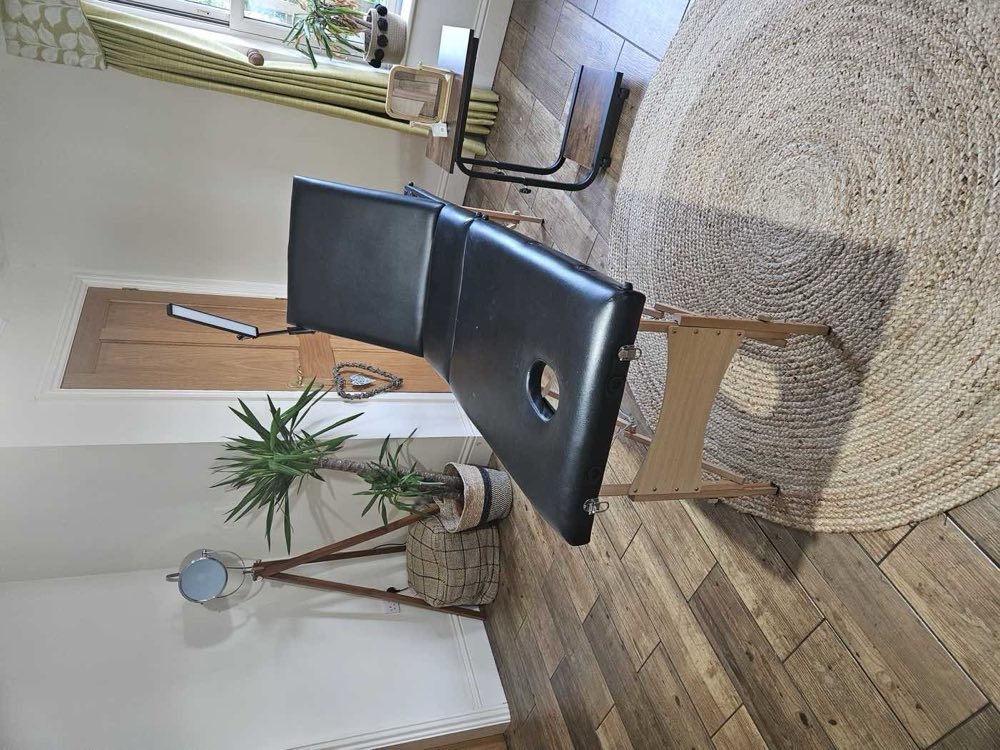
A private clinic room on a farm between Spalding and Boston, with free parking at the door.
Glebe Farm, Church EndApproximate driving times from each town centre, in normal traffic, checked against a route planner.